












 Best Books on Telepathy
 5 Books That Should Be Adapted Into Movies
 Exploring the Evolving World of Online Casino Culture with WinSpirit
 Win Airlines and the Expanding Landscape of Adult Digital Entertainment
 When VegasNow Sets the Stage for Immersive Casino Atmosphere
 How Wild Tiger Slot Fits Into the Way We Play and Unwind Today
 Inside Vegas Plus: Where Casual Players Meet the Energy of Modern Online Entertainment
 Inside the Modern Mobile Casino Scene: How Tropicanza Fits Today’s On-the-Go Play Habits
 How to Store Your Book Collection Safely in Vancouver’s Climate
 AI in Literary Recruitment: How AI Tools Help Find Top Writers and Editors
 Top 10 Must-Read Books of 2023: Unleash Your Inner Bookworm
 Top 10 E-commerce Books Every Online Entrepreneur Must Read
 Exploring the Benefits of Library and Book Resources for Writing Papers
 Top Japan Books to Read in All Time
 Best Sellers in Poker (According to House of Pokies)
Sometimes you can feel like you and someone else understand each other without talking. Of course, this could also be called non-verbal communication. But it can feel more intricate than that. So, if you want to understand the subject a little better and the experiments around it, we recommend these five books.
Although it is possible to learn about telepathy through books, you cannot fully understand it just by reading. You have to actually try it yourself.
Nowadays, VEREVIO Mind Reader trainer gives you a playground for telepathy training. Your progress is tracked across five different metrics, such as z-score, random probability, etc., so you can actually see how you are doing.
But first things first. Let’s get back to the theory and the books worth reading.
#1 Mind Reach by Russell Targ and Harold Puthoff
From a research perspective, this is probably one of the best places to start.
Russell Targ and Harold Puthoff were researchers at Stanford Research Institute who became well known for their experiments involving psychic phenomena and remote viewing. Mind Reach describes some of their work and covers experiments involving telepathy, clairvoyance, and remote viewing.
#2 Dream Telepathy by Montague Ullman and Stanley Krippner
Can telepathic communication happen while we are asleep?
That is the main question explored in Dream Telepathy. Montague Ullman and Stanley Krippner conducted a series of experiments at the Maimonides Medical Center in New York, where they studied whether information could be transferred from one person to another through dreams.
This is one of the more unusual books on the list because it combines telepathy with dreams and altered states of consciousness. Even if you are skeptical about the results, the experiments themselves are fascinating to read about.
#3 Entangled Minds by Dean Radin
Dean Radin is known for his work in parapsychology and consciousness research. In this book, he discusses experiments involving telepathy, precognition, intention, and other forms of what he calls “nonlocal” consciousness.
One of the main ideas is that distance may not always matter as much as we think when it comes to certain mental experiences. The book looks at laboratory experiments as well as ideas from physics and consciousness research.
This does not mean that every reader will agree with Radin’s conclusions. There are plenty of skeptics, especially when scientific concepts are used to explain psychic phenomena.
Still, the book is useful because it gives readers a broad overview of modern experiments in the field. It is probably a good choice for someone who wants to move beyond old stories about telepathy and see what researchers have been studying more recently.
#4 Mental Radio by Upton Sinclair
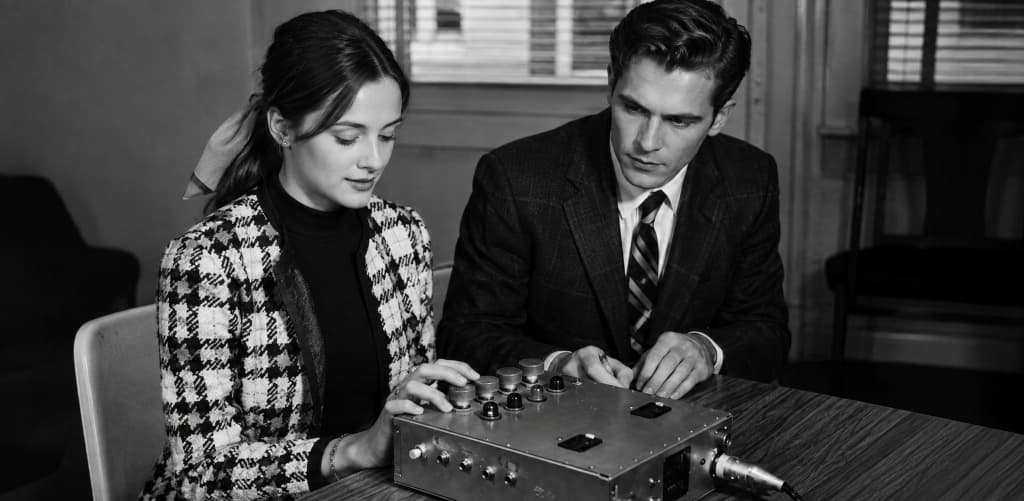
Upton Sinclair was a famous American writer, best known for novels rather than psychic research. But in Mental Radio, he documented a series of telepathy experiments involving his wife, Mary Craig Sinclair. Over several years, she attempted to reproduce drawings made by Sinclair and others without seeing the originals, including long-distance experiments.
The book is particularly interesting for its detailed drawings and descriptions of the results. Mary also describes her own method of receiving impressions, making it useful for anyone interested in the practical side of telepathy and remote viewing.
The book received attention from psychologist William McDougall, who wrote the introduction, and the revised edition also includes a report by psychical researcher Walter Franklin Prince analyzing the experiments.
#5 Experiments in Mental Suggestion by L. L. Vasiliev
L. L. Vasiliev was a Soviet physiologist who studied what he described as mental suggestion and the possibility of influencing another person without ordinary communication.
The experiments discussed in this book often focused on whether one person could affect another person’s mental state from a distance. This included attempts involving sleep, waking, and different forms of suggestion.
Compared with some of the other books on this list, this one feels more scientific and technical. It is less about personal experiences and more about experimental attempts to test a specific idea.
That makes it particularly interesting for readers who want to see how researchers in another country and another period approached telepathy.
The book was written many decades ago, so some of its methods and terminology feel outdated today. Still, it provides an interesting historical look at how seriously the subject was investigated in Soviet science.
Telepathy is a difficult subject to study because the experiences people describe are often personal and hard to reproduce. That is probably why these books are so different from one another. Some focus on laboratory experiments. Others focus on dreams, personal cases, or theories about consciousness.
Reading them will not tell you for certain how telepathy works. But they will give you a better understanding of why people have been interested in the subject for so long — and why some researchers continue trying to explore it.